Iron Rails and Wandering Souls: Why Train Songs Have Always Been America's Portal Music
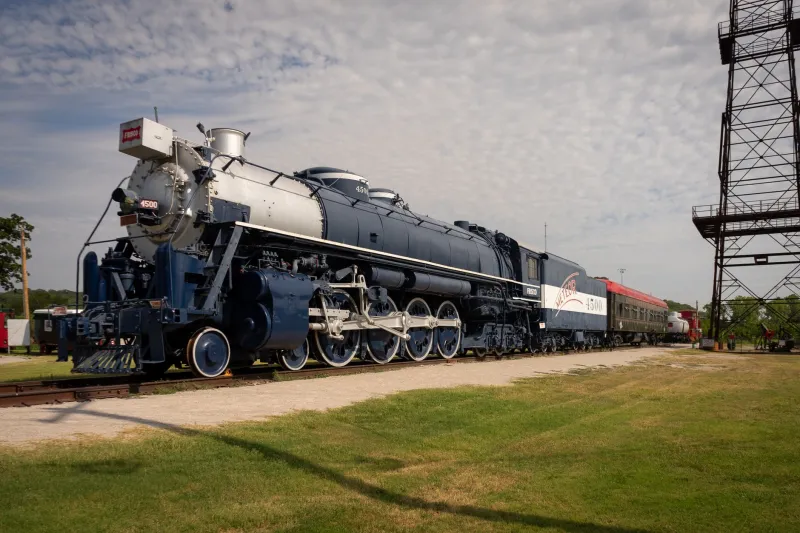
There's a moment in a lot of old train songs where everything gets quiet except for the wheels. That steady clack-clack rhythm, repeating underneath the melody like a second heartbeat — it's hypnotic in a way that doesn't feel entirely accidental. Musicians who wrote about trains weren't just documenting transportation. They were mapping something older, something that had no other shape in American life quite as perfect as a locomotive vanishing into the horizon.
Trains, it turns out, have always been America's mythology machine.
The Track as a Threshold
In folklore from dozens of cultures, the liminal space — the in-between place where the rules of the living world get fuzzy — tends to be a crossroads, a riverbank, or a doorway. In American mythology, the railroad track filled all three roles at once. It was the crossroads you could follow in a straight line. It was the river you could ride. And it was a doorway that kept moving, which made it even more dangerous and more sacred.
When Delta blues singers picked up their guitars and started writing about trains in the early twentieth century, they weren't being metaphorical just for the sake of poetry. The railroad had carved through communities, separated families, and carried people away from everything they knew — sometimes forever. That kind of rupture leaves a mark on a place, and music is often the first thing to register it.
Blind Lemon Jefferson's recordings from the 1920s are full of trains that feel less like machines and more like forces of nature with intentions. The rhythm of his picking mimics the percussion of wheels on iron, and the effect isn't just stylistic — it's incantatory. You're not listening to a song about a train. You're being placed beside the tracks at dusk, which is exactly when the old stories say the membrane between worlds gets thin.
Hank Williams and the Ghost in the Whistle
Skip forward a few decades and you find Hank Williams doing something remarkably similar with a completely different sound. "The Funeral" and his spoken-word Luke the Drifter recordings carry the same freight as those Delta blues tracks — a wandering figure, unmoored from home, moving through a landscape that doesn't quite belong to the living.
Williams himself was famously described as someone who seemed to exist slightly outside of ordinary time, and his train imagery reflects that. The lonesome whistle in his work isn't just a sound effect. It's a signal, the kind you hear when something is crossing from one state of being into another. Country music scholars have noted for years that Williams wrote about death with a comfort level that suggested he'd already made peace with it — or maybe had already met it halfway.
The train whistle, in this context, becomes the sound of that meeting.
"Mystery Train" and the Mythology of Disappearance
Few songs in American music have done more mythological heavy lifting than "Mystery Train," the number that passed through the hands of Junior Parker and then Elvis Presley in the early 1950s. On the surface it's a breakup song. But listen to what the train actually does in the lyrics — it takes someone away and doesn't bring them back. The singer is left at the station, watching something disappear that he knows isn't coming home.
That's not a love story. That's a ghost story with a backbeat.
The "mystery train" of the title has no schedule, no known destination, and no guarantee of return. In the vocabulary of American mythology, that's the train that crosses over. The one that carries souls. The fact that it sounds absolutely electrifying and makes you want to dance is part of the tradition too — grief in American music has never been required to stay still.
The Rhythm That Mimics a Heartbeat
One of the most consistent things across railroad songs — from Leadbelly's "Midnight Special" to Johnny Cash's "Orange Blossom Special" to Elizabeth Cotten's quietly devastating "Freight Train" — is that rhythmic pulse underneath everything. Musicologists sometimes call it a train groove, but it's worth sitting with what that rhythm actually does to a listener.
It regulates you. It pulls your breathing into sync with it. And then, when the song is about loss or departure or death, it creates this uncomfortable sensation of being carried somewhere you didn't choose to go.
Elizabeth Cotten recorded "Freight Train" when she was barely a teenager, and she played it with a fingerpicking style so fluid that the rhythm feels almost inevitable — like gravity rather than music. The song is about watching trains pass her childhood home and wanting to be on one when she dies, buried down by the tracks. It's a wish about where to rest, but it's also a wish about staying close to the portal. About being near the place where things cross over.
That's a deeply mythological impulse dressed up in the most unassuming folk song imaginable.
Why the Restless Dead Ride Trains
American ghost lore has a particular fondness for train-related hauntings. Phantom locomotives, spectral passengers, the ghost of someone killed at a crossing who still tries to flag down the 11:15 — these stories appear in nearly every region of the country, and they share a common logic. Trains are things that move between places. Ghosts are souls stuck between states. Of course they'd find each other.
The music understood this before the folklore fully articulated it. When a blues singer wailed about waiting for a train that never came, audiences in the 1920s and 30s heard something in that image that went beyond literal transportation. They heard the ache of unfinished business. The restlessness of someone who died mid-journey and couldn't figure out how to stop moving.
That's what the best train songs have always carried in their cargo hold — not just stories about going somewhere, but stories about souls that can't stop trying.
Still Boarding
The tradition hasn't stopped. Artists from Tom Waits to Gillian Welch to Rhiannon Giddens have picked up the train metaphor and run with it into the twenty-first century, each one finding new ways to load it with the same ancient freight. The portal is still open. The rhythm is still running.
Next time a train song comes on — any train song, really — listen for what's underneath the melody. That steady percussion, those wheels on iron, that pulse that sounds just a little too much like a heartbeat to be entirely comfortable. Someone put that there on purpose. And they weren't just writing about a machine.