Two Voices, One Ending: The Long, Sad History of the American Duet
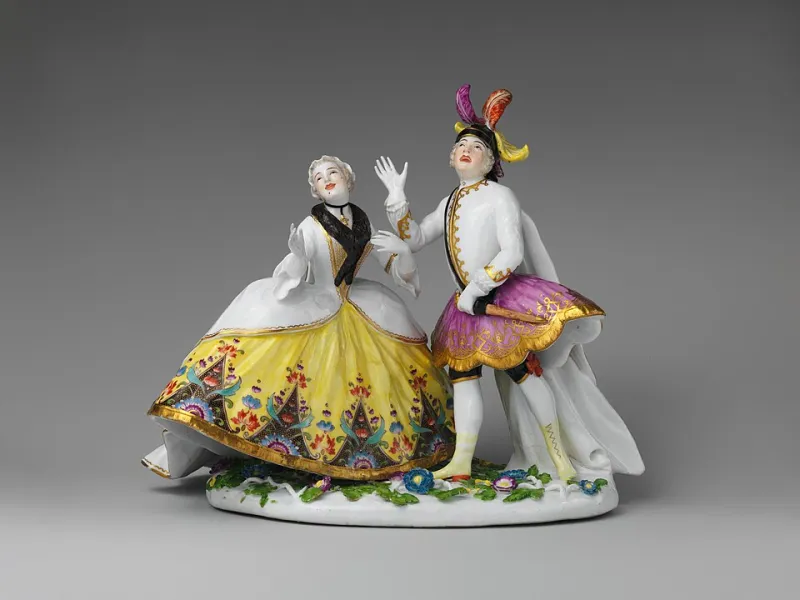
Photo: Johann Joachim Kändler, CC0, via Wikimedia Commons
There's a moment in almost every great American duet when you can hear it coming. The harmonies are too perfect. The voices are too well-matched. Something in your chest tightens, not from joy but from a kind of low-grade dread — because you've been here before, and you know how this goes.
The duet ends. And usually, so does something else.
The Pattern Nobody Talks About
Pull back and look at the American musical tradition from a wide enough angle, and a pattern emerges that's hard to unsee once you've noticed it. Two voices come together — in a folk ballad, a Broadway number, a country duet, a pop collaboration — and the act of joining creates something beautiful and unstable in equal measure. The harmony is the warning.
This isn't a modern phenomenon. It goes all the way back to the oldest ballads carried over from the British Isles and planted in American soil, where they mutated and darkened. Songs like "Barbara Allen" and "Knoxville Girl" aren't really love songs — they're duets that exist to stage a collapse. Two people in perfect tragic alignment, moving toward an ending that was written before the first note.
The folk tradition is full of them. Two voices, two people, one catastrophic conclusion. The harmony isn't a sign of unity. It's a countdown.
Broadway Knows the Curse by Name
American musical theater has practically built an entire grammar around the doomed duet. Think about how many of the genre's most celebrated songs are two characters singing together at the exact moment before everything falls apart.
"Tonight" from West Side Story is the obvious case — Tony and Maria in perfect, soaring harmony, and the audience already knows what's coming because the whole show is a mythology of inevitable tragedy. The more beautiful the duet, the closer the ending.
But it goes deeper than the obvious examples. "The Last Midnight" in Into the Woods uses duet structure to expose a fracture. "Finishing the Hat" in Sunday in the Park with George is a duet with an absence — one voice singing to someone who isn't really there. Even "People Will Say We're in Love" from Oklahoma! frames romantic harmony as something that has to be hidden, as if the culture already knows that two voices joining is a dangerous thing to advertise.
Broadway didn't invent this anxiety. It inherited it, polished it, and put it under a spotlight.
Country Music's Particular Cruelty
If Broadway is knowing about the duet curse, country music is almost gleeful. The genre has produced some of the most gorgeous and most devastating vocal pairings in American history, and the ratio of tragedy to triumph is not close.
Dolly Parton and Kenny Rogers gave us "Islands in the Stream" — a song so warmly matched it feels like a homecoming — and yet even there, the lyrics are about two people who only make sense together, which is another way of saying they're incomplete alone. The harmony is the dependency. The beauty is the vulnerability.
Tammy Wynette and George Jones are the genre's most famous example, and their story collapsed so completely off-stage that it retroactively infected every song they recorded together. You can't hear "Golden Ring" now without knowing what came after. The duet became an artifact of a wreck.
And then there's the broader tradition of the "answer song" — one artist recording a response to another's track, two voices in conversation across separate recordings that never quite meet. It's a duet with a wall in the middle. Close enough to harmonize, too far apart to actually touch.
Why Does This Keep Happening?
There are a few theories worth sitting with.
One is purely structural. Duets create dramatic tension by putting two distinct voices in the same space, and dramatic tension needs somewhere to go. Resolution in a duet almost always means one voice subsumes the other, or they separate, or the song ends — which is a kind of small death regardless. The form itself resists permanent unity.
Another theory is cultural. American mythology has always been deeply suspicious of merger. The national story is built around individual voices — the lone hero, the self-made person, the singular vision. Two voices joining together challenges that mythology at a fundamental level. The culture keeps writing duets that fall apart because it doesn't fully trust what happens when two things become one.
There's also something worth saying about the way American music has historically staged relationships between people across lines of difference — race, gender, class, region. A lot of the most powerful duets in this country's musical history were pairings that the culture around them was actively trying to prevent. The tragedy in those songs wasn't metaphorical. It was documentary.
Does Anyone Break the Curse?
It would be dishonest to say nobody makes it out. There are duets that land somewhere other than wreckage.
Some of them survive by becoming performances of harmony rather than actual unions — two artists who come together for a song and then return to their separate careers, the collaboration existing in a protected space outside of narrative consequence. Simon and Garfunkel's best work, for all its eventual real-world fracture, contains moments of genuine vocal peace. The Everly Brothers harmonized in a way that sounded like one person thinking out loud.
And occasionally, something genuinely breaks the pattern. Mavis Staples and Levon Helm's late-career recordings together have the quality of two old friends who found each other at exactly the right time and made something that didn't need to end. The harmony there doesn't feel like a countdown. It feels like an arrival.
But those examples are rare enough to prove the rule. The American duet, across its long and complicated history, has a gravitational pull toward loss. Two voices join. Something beautiful happens. And then — almost always — the harmony breaks.
What the Song Is Actually Saying
Maybe the duet curse isn't a curse at all. Maybe it's an honest accounting.
Every harmony is temporary. Every collaboration has a last session. Every relationship between two voices — musical or otherwise — eventually reaches a point where the song ends and the silence comes back in. The American duet keeps staging tragedy not because the culture is pessimistic, but because it's paying attention.
Two voices singing together is one of the most beautiful things a human being can witness. The fact that it doesn't last forever doesn't make it less real. It might be what makes it matter at all.
The melody meets the myth, and what it tells us — every time, in every genre, across every era — is that the joining was worth it. Even knowing the ending.