Between the Pew and the Veil: How Southern Gospel Secretly Preserved a World Full of Spirits
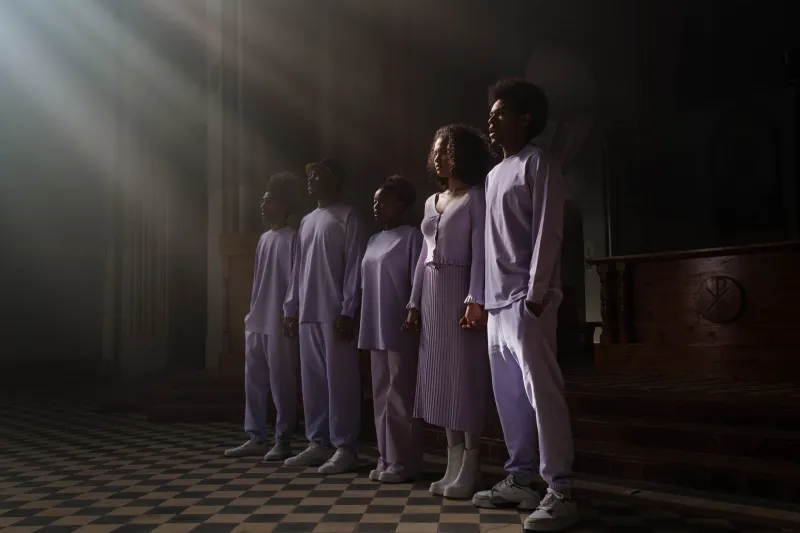
Walk into almost any small-town Southern church on a Sunday morning and you'll hear it — that particular kind of singing that seems to come from somewhere deeper than the chest. It rises up through the floorboards, shakes the windows, and hangs in the air long after the last note fades. Most folks call it gospel. But if you listen a little closer, lean in past the familiar scripture and the four-part harmony, you'll catch something else entirely. Something older. Something that was never fully at home inside a church building to begin with.
Southern gospel — and its ancestor, the African American spiritual — was never just religious music. It was a mythological library. A coded archive. A survival manual for people who understood, bone-deep, that the world doesn't end at the edges of what you can see.
The Congregation Knew What the Lyrics Really Meant
Historians and musicologists have spent decades documenting how enslaved Black Americans used spirituals to encode practical information — directions on the Underground Railroad, warnings about overseers, signals between communities. That much is well-established. But the supernatural layer of these songs is talked about far less, and it runs just as deep.
When a congregation in the Georgia lowcountry sang about crossing the River Jordan, they weren't only gesturing toward the afterlife or freedom up North. They were also invoking a cosmology rooted in West and Central African spiritual traditions — particularly those of the Bakongo people — where rivers mark the boundary between the world of the living and the realm of the ancestors. The water wasn't metaphor. The water was a threshold, and everyone in that room understood it that way.
The Gullah Geechee communities of coastal South Carolina and Georgia were especially deliberate about this. Their sacred music existed in direct conversation with a belief system that included haints — restless spirits of the dead — and the practical need to keep them from crossing back over. That's not superstition dressed up in a hymn. That's mythology with a melody, and it served a real cultural function.
Shape-Shifters in the Choir Loft
Appalachian gospel traditions brought their own supernatural freight to the table. The Scots-Irish settlers who pushed into the mountain hollows of Kentucky, Tennessee, and West Virginia carried with them a rich oral tradition of shape-shifters, witches, and liminal beings — and when those traditions collided with African American folk belief and Protestant revival culture, the resulting music got genuinely strange in the best possible way.
Consider the recurring gospel motif of the "stranger on the road" — a figure who appears unexpectedly, offers wisdom or a warning, and then vanishes before anyone can ask his name. On the surface, it's a Jesus-on-the-road-to-Emmaus reference. But in the mountain communities where these songs circulated, that stranger also carried the shadow of older figures: the trickster who walks in disguise, the spirit that tests the living, the shape-shifter who might be your neighbor or might be something wearing your neighbor's face. The congregations singing these songs held both meanings at once, and neither one canceled the other out.
Songs like "Wayfaring Stranger" — with its haunting, first-person account of traveling through a world of woe toward some distant home — drew on this ambiguity deliberately. Is the singer a living person longing for heaven? A ghost who doesn't know it's dead yet? A spirit caught between worlds? Appalachian listeners weren't confused by the question. They were comforted by a song that acknowledged all three possibilities simultaneously.
Protective Magic Hidden in Plain Harmony
One of the most fascinating threads running through Southern gospel is the use of song as literal protection — not symbolic, not metaphorical, but functionally magical in the way that folk communities understood magic to work.
In African American hoodoo tradition, which flourished throughout the South and especially in Louisiana and the Mississippi Delta, certain prayers and songs were understood to create a kind of spiritual barrier. Singing the right words in the right way could keep a haint from crossing your threshold, could break a hex, could call down a protective ancestor. These practices didn't disappear when communities embraced Christianity. They got folded into it, tucked inside the familiar language of hymns and spirituals where they could survive.
"This Little Light of Mine" sounds cheerful and simple — it's a children's song now, practically wallpaper. But its origins carry a more serious charge. Light, in the folk magic traditions woven through Southern Black culture, was a genuine protective force. Candles were lit to ward off evil. Mirrors were covered when someone died so spirits couldn't get trapped in the reflection. Singing about light wasn't just praise. It was a declaration of spiritual armor, and older listeners in certain communities would have recognized it that way.
Similarly, the spiritual "Hush, Somebody's Calling My Name" reads on one level as a meditation on divine calling. On another level, it's a warning. In Southern haint lore, hearing your name called by an unknown voice — especially at dusk, especially near water — was a sign of danger. The song doesn't resolve that tension. It sits right inside it, which is exactly where good mythology lives.
The Thin Place Between Praise and the Paranormal
Celtic traditions have a concept called "thin places" — locations where the boundary between the physical world and whatever lies beyond it becomes unusually permeable. Southern gospel culture had its own version of this idea, and it showed up most powerfully in the music of the old brush arbor revivals and the shape-note singing schools that spread through rural communities in the 18th and 19th centuries.
Shape-note hymnody — the Sacred Harp tradition, still practiced in parts of Alabama, Georgia, and Texas — produces a sound that is genuinely unlike anything else in American music. The open, droning harmonies, the absence of a designated melody line, the way the voices lock together and then seem to pull apart: it creates an acoustic environment that feels, even to secular ears, like it's operating on more than one frequency. Shape-note singers will tell you that the music puts them somewhere else. Somewhere between here and not-here.
That's not an accident. The communities that developed and preserved shape-note singing were deeply aware of the supernatural dimensions of communal voice. They understood that certain combinations of sound could thin the veil, could invite the ancestors in, could make the spirits of the recently departed feel close enough to touch. The music was devotional and it was also, in the most literal folk sense, a séance.
Why This Still Matters
Southern gospel is having something of a cultural moment right now — showing up in film scores, sampled by hip-hop producers, covered by indie artists who are drawn to its emotional directness. That's great. But there's a risk that the music gets appreciated only for its surface beauty while its deeper mythological architecture gets lost.
The haints are still in there. The shape-shifters are still lurking at the edges of those harmonies. The protective magic is still encoded in lyrics that sound simple until you know what you're listening for.
Next time a gospel choir cuts loose and you feel that particular shiver run up your spine — the one that has nothing to do with temperature — maybe consider that you're not just being moved by beautiful music. Maybe you're brushing up against a mythology that survived everything thrown at it by hiding in the one place nobody thought to look: the Sunday morning song.
The congregation always knew what the words really meant. Now you do too.