Dropping the Needle, Raising the Dead: What Vinyl Collectors Are Really Searching For
Walk into any Record Store Day gathering and you'll notice something strange. People aren't just shopping. They're searching. Fingers flipping through crates with the careful patience of someone reading tea leaves, eyes scanning sleeve art like it contains a message meant specifically for them. The vinyl revival gets written off constantly as nostalgia or audiophile snobbery, but that explanation has always felt too thin. Too easy.
Here's a wilder theory: record collecting is a form of spiritual archaeology, and the people doing it are trying to excavate something ancient from inside their own chests.
Before Spotify, There Were Storytellers
For most of human history, music wasn't something you consumed. It was something that happened to you, in a specific place, at a specific time, with other people present. A shaman chanted. An elder sang a lineage into existence. A traveling bard sat by your fire and made the world feel both bigger and safer in the same breath.
These weren't passive experiences. They required preparation, presence, and a kind of deliberate openness that we've almost entirely engineered out of modern life. Oral traditions weren't just about transmitting information — they were ceremonial. The act of gathering to receive a story was itself the point.
Streaming dismantled all of that. Algorithmically curated playlists are efficient and endlessly convenient, but they've stripped music of its ceremony. You don't choose. You don't commit. You shuffle.
Vinyl refuses to let you do that.
The Ritual in the Routine
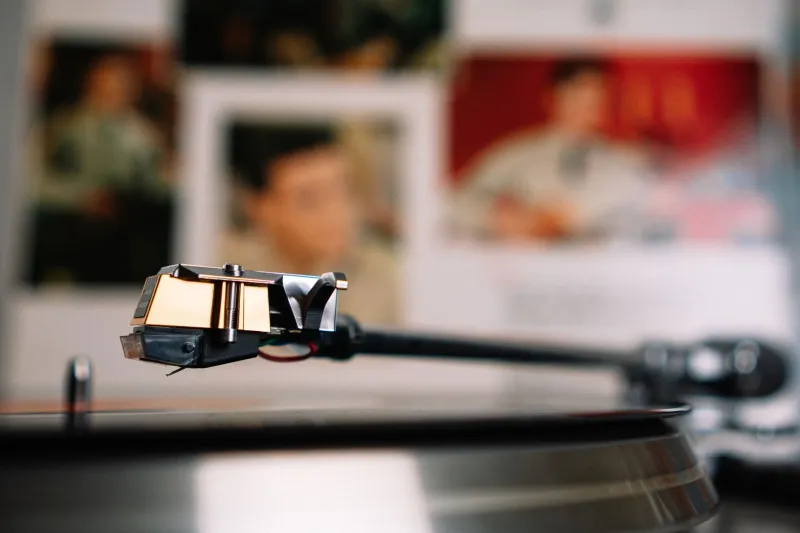
There's a specific sequence of actions involved in playing a record that no other format demands. You select the album — already a more intentional choice than clicking a thumbnail. You slide it from its sleeve. You check the surface for dust, hold it at an angle to catch the light. You set it on the platter, line up the tonearm, and lower the needle with the kind of care you'd give something fragile and irreplaceable.
Then you sit down. Because vinyl asks you to sit down.
This is not accidental. It's ritual behavior — a sequence of repeated, purposeful actions that signal to your brain: something meaningful is about to happen. Anthropologists have documented for decades how ritual action primes humans for deeper emotional and communal experience. Whether you're lighting a candle before prayer or cleaning a record before you play it, you're doing the same psychological work.
The liner notes complete the picture. Reading the credits, the thank-yous, the lyrics printed in someone's actual handwriting — these transform a recording into an artifact. A relic. Something that once belonged to a specific human being who had fears and debts and a favorite diner and a reason they wrote that particular song on that particular night.
Hearing Your Ancestors in the Crackle
Millennials — the generation most aggressively associated with the vinyl resurgence — grew up in a peculiar moment. Old enough to remember life before the internet, young enough to have been fully absorbed by it. They're the generation that watched physical media disappear in real time, and many of them feel, on some level, that something important left with it.
What they're chasing in those crates isn't just their own childhood. It's something older. The crackle and pop of a needle on vinyl sounds, to many listeners, like a fire. Like a room full of people who knew things they never wrote down. There's a reason so many collectors describe the experience of playing a grandparent's old record as genuinely emotional — even if they never met that grandparent.
Sound carries memory in ways neuroscience is only beginning to map. A recording made in 1967 still holds the acoustic fingerprint of the room where it was cut, the breath of the musicians, the ambient hum of the city outside the studio window. When you play it on the equipment it was designed for, you're not just hearing the music. You're hearing the world that made it.
That's not nostalgia. That's communion.
The Crate Digger as Mythkeeper
In cultures that maintained strong oral traditions, there were always designated keepers — people whose job was to remember, to preserve, to pass things forward. They were respected figures because everyone understood that once a story stopped being told, it was gone in a way that nothing could fully recover.
Vinyl collectors, whether they'd frame it this way or not, have stepped into a version of that role. They're preserving not just music but the context of music — the way an album was sequenced, the way a B-side complicated the narrative of the A-side, the way a gatefold sleeve turned a listening session into an immersive experience that a streaming thumbnail simply cannot replicate.
Every record store is a kind of archive. Every collector's shelf is a library of voices that might otherwise go silent.
What the Needle Is Really Saying
Maybe the most honest way to understand the vinyl revival is this: in a world that has made music infinitely available, people are desperately trying to make it meaningful again.
The ceremony matters. The weight of the record in your hands matters. The fact that you can't skip a track without physically moving the needle — that matters too. It forces you to sit with discomfort, with a slow build, with a song you might have dismissed on a playlist but that opens up completely when you let it breathe.
Your ancestors sat around fires and let stories work on them. They didn't fast-forward. They didn't shuffle. They received.
When you drop a needle on a record and settle into your chair, you're doing exactly what they did. You're making yourself available to something larger than the moment.
The music has been waiting. It just needed someone willing to do the ritual right.