Ring Around the Dark: The Sinister Truths Your Favorite Childhood Songs Were Keeping From You
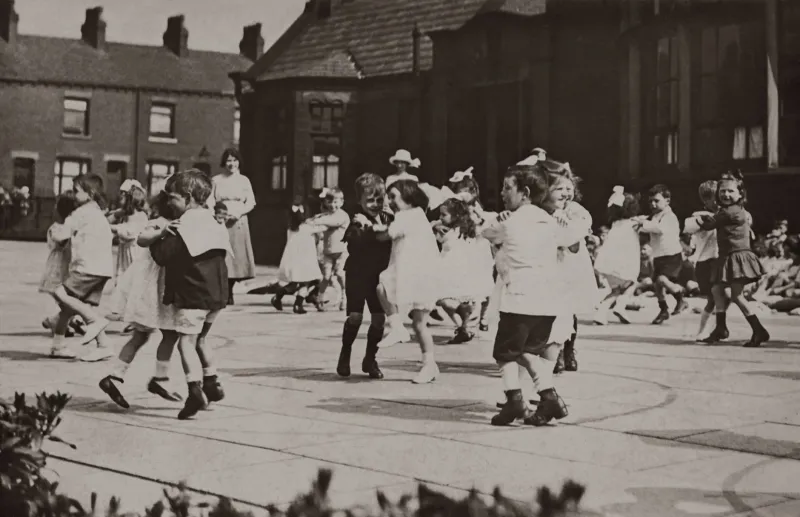
Somewhere in America right now, a group of small children are holding hands in a circle, spinning around, and singing cheerfully about falling down. They have no idea. Their parents, watching from a bench nearby, probably don't either. And that's exactly how it was designed to work.
Children's songs are one of the oldest and most effective delivery systems for information that adults didn't want to say out loud. Before mass literacy, before broadcast media, before the internet made every secret findable in seconds, a rhyme set to a catchy melody could carry a warning, a protest, or a piece of forbidden history across generations — wrapped in enough innocence that nobody in power thought to stop it.
Let's unwrap some of that innocence.
The Plague Song You Sang at Recess
"Ring Around the Rosie" is probably the most famous example, and also one of the most debated. The plague theory — that the rhyme describes symptoms of the Black Death, with the "rosie" referring to a rash, the "posies" to herbs carried to ward off infection, and "we all fall down" to mass death — has been popular since the 1960s. Folklorists like Peter and Iona Opie pushed back on it, arguing the rhyme only appeared in print in the late 19th century, well after the medieval plagues.
But here's what's interesting: the debate itself reveals something important. We want this song to be about the plague. We recognize, instinctively, that something dark belongs inside something this cheerful. The structure of the rhyme — the circle, the spinning, the sudden collapse — carries a physical choreography of communal doom that feels like it should mean something terrible.
Whether or not the plague theory is historically accurate, the impulse behind it is sound: children's songs have always been a place where darkness gets laundered into something singable.
London Bridge and the Bodies in the Foundation
"London Bridge Is Falling Down" sounds like a simple engineering complaint. It's not.
The song has been traced back to at least the 17th century, and some researchers connect it to an ancient and extremely grim European building practice: the idea that a structure could only be made permanent by sealing a living person — often a child — inside its foundation. The spirit of the sacrifice would then become the guardian of the bridge, keeping it standing through sheer supernatural obligation.
The line "my fair lady" at the end of the rhyme has been interpreted as a reference to this sacrifice — the "lady" being the soul sealed inside the stone. Whether that's the literal origin or a layer of meaning that accumulated over centuries of singing, the image is striking. An entire generation of American children has merrily sung about structural collapse and possible ritual burial without once being told what they might be commemorating.
That's not an accident. That's mythology doing its job.
"Mary, Mary" and the Queen Who Killed
Nursery rhymes weren't always folkloric accidents. Some of them were deliberate political commentary, encoded in rhyme to avoid the kind of consequences that came with saying unpopular things about people who had the power to punish you for it.
"Mary, Mary, Quite Contrary" is widely believed — though again, not universally confirmed — to be a portrait of Mary I of England, known to history as Bloody Mary for her enthusiastic persecution of Protestants. In this reading, "her garden" is a cemetery, growing with the bodies of those she executed. The "silver bells and cockle shells" are instruments of torture. The "pretty maids all in a row" are the guillotines, lined up and ready.
In an era when saying any of this plainly would have been a death sentence, a nursery rhyme could carry the whole story safely — disguised as a comment on a difficult woman's gardening habits.
This is the tradition that shaped American children's music before it was ever called American. The Puritan settlers brought these songs across the Atlantic, and they brought with them the understanding that a rhyme could hold what a pamphlet couldn't.
American Additions to the Dark Songbook
The tradition didn't stop at the shore. American children's songs developed their own mythology, often drawing on the particular anxieties of a young, violent, rapidly expanding nation.
"Hush Little Baby," that sweet lullaby promising gifts to a crying child, has a structure that folklore scholars have noted is essentially a bribery list — a parent bargaining desperately with an inconsolable infant, promising mockingbirds and diamond rings and looking glasses. The song ends with the parent running out of things to promise: "and if that horse and cart fall down, you'll still be the sweetest little baby in town." It's a lullaby that ends in failure. The comfort is conditional, the resources exhausted, the final promise basically just "I still love you even though everything went wrong."
For a nation built by people living on the edge of survival, that's not just a song. That's a theology.
"Go Tell Aunt Rhody" — that mournful little tune about the old gray goose — is a death song. It's a child being sent to deliver news of an animal's death, learning in the process how to be the bearer of bad news, how to participate in the community ritual of telling and being told. "The old gray goose is dead" is a rehearsal for harder conversations. A training ground for grief.
Why We Keep Handing These Songs to Children
The question worth sitting with is not just what these songs contain, but why we keep passing them down. Why, when we know perfectly well that "Ring Around the Rosie" has plague associations (accurate or not), do we still teach it to three-year-olds in preschool circles?
Folklorist Alan Dundes argued that children's folklore serves as a safe container for anxieties that adults can't address directly. By encoding fear, death, violence, and social chaos into a rhyme with a bouncy melody and a predictable ending, we give children a way to rehearse difficult emotional terrain without being overwhelmed by it.
The song is a myth in miniature. It says: here is something scary. Here is a shape for it. Here is a rhythm you can hold it in. Sing it enough times and it stops being terrifying and starts being familiar.
That's not a bad deal, honestly. That's what mythology has always offered — not the removal of darkness, but a melody you can use to walk through it.
The Tune Underneath the Tale
At Tunes For Tales, we spend a lot of time thinking about the places where music and story do something together that neither could do alone. Children's songs might be the oldest version of that collaboration we have.
The next time you hear a child singing one of these rhymes — spinning in a circle, clapping their hands, falling down on cue — listen for what's underneath the melody. There's a whole archive in there. Centuries of fear and warning and coded history, set to something you can hum while you're doing the dishes.
Somebody worked very hard to make it sound that simple.