The Invisible Architecture: How Movie Scores Build Your Memories Without You Noticing
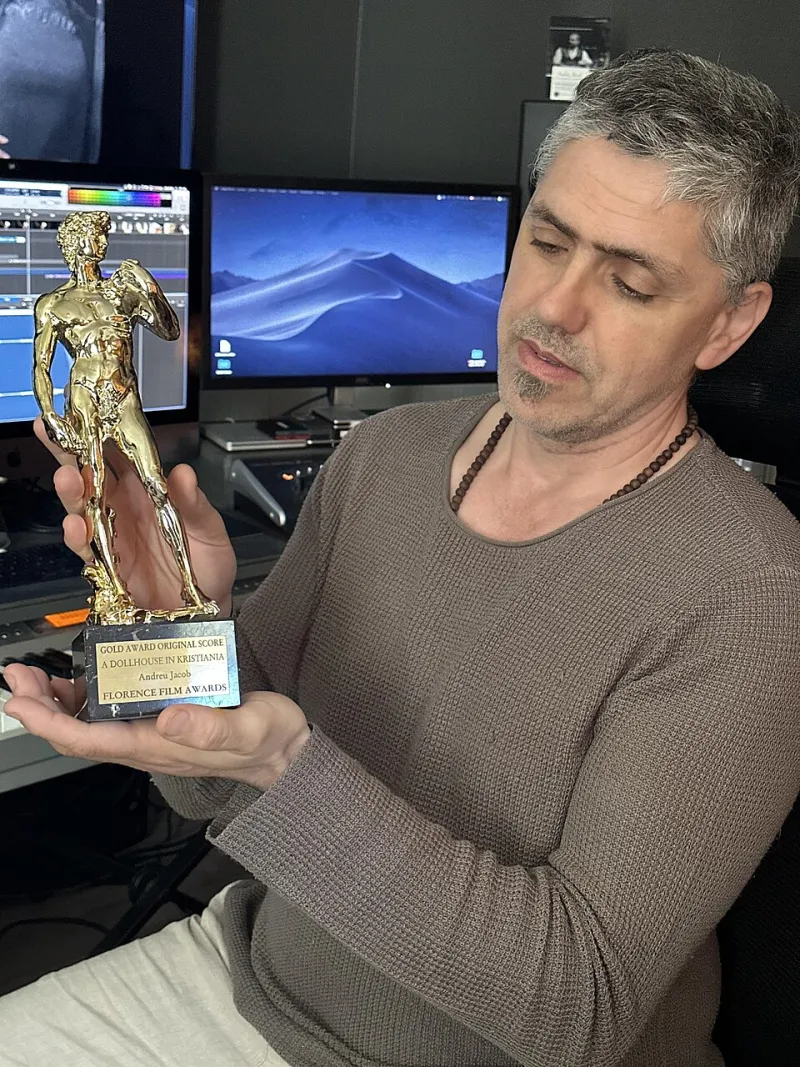
Photo: EvaMarlen, CC BY-SA 4.0, via Wikimedia Commons
Picture the moment. You know the one — a character standing in the rain, or a door closing for the last time, or a reunion that took two and a half hours to earn. You remember the feeling in your chest. You remember what the light looked like. You might even remember what you were eating in the theater. What you probably can't do, if someone asked you right now, is hum what was playing underneath all of it.
That's not a flaw in your memory. That's the whole design.
The Score That Wasn't Supposed to Be Heard
Film composers have a phrase for what they're chasing: transparent emotion. The goal isn't to write something listeners will walk out humming. It's to write something so deeply embedded in the scene that the two become inseparable — and then the music disappears entirely into the story.
Bernard Herrmann, the guy behind Psycho's shrieking strings, once said the composer's job is to "add what the actor cannot express." Not to announce itself. Not to take a bow. Just to fill the emotional gap between what's on screen and what the audience needs to feel.
And it works almost too well. Music psychologists call this the soundtrack effect — a cognitive phenomenon where the music and the memory fuse so completely that the brain essentially files them as one thing. You don't remember the melody. You remember the feeling. The melody was just the delivery mechanism.
Why Your Brain Gives the Story All the Credit
Here's the weird part: the music is often doing more emotional work than the visuals. Studies on film perception consistently show that changing a scene's score can flip its emotional reading entirely — the same footage can feel tragic, triumphant, or terrifying depending on what's underneath it. The music is the meaning. The images are just the occasion.
So why does the story get all the glory in our memories?
A big part of it comes down to attention. When we watch a film, our conscious focus is tracking narrative — who wants what, what's at stake, what happens next. That's a high-bandwidth cognitive task. Music, meanwhile, sneaks in through a different door. It processes emotionally and subconsciously, which means it shapes how we feel without ever competing for our attention.
The result is a kind of memory laundering. The emotion gets deposited into the scene, and the music — the actual source of that emotion — quietly walks away without leaving a name.
The Composers Who Knew Exactly What They Were Doing
Not every film composer is comfortable being invisible. John Williams has talked openly about the tension between writing music that serves the scene and writing themes that have a life outside the theater. His approach — big, melodic, almost operatic — is one reason you can hum the Star Wars theme or the Jaws two-note pulse. He built in escape hatches. Hooks that survive the film and live in the open air.
But composers like Ennio Morricone, Jonny Greenwood, or more recently Nicholas Britell work in a different tradition. Their scores are architectural. They hold the emotional structure of the film in place the way load-bearing walls hold up a house — you'd notice immediately if they were gone, but you never think about them while you're living inside the space.
Greenwood's work on There Will Be Blood is a perfect example. Those jarring, dissonant strings feel less like a score and more like a geological force — something ancient and indifferent pressing up through the story. You feel it. You might not be able to name it.
Streaming Changed the Rules a Little
Something genuinely interesting has started happening in the last decade. Streaming platforms and the culture around them have quietly started pulling film scores back into visibility.
Spotify playlists dedicated to film scores rack up millions of streams. "Sad Study Music" playlists are basically ambient score compilations. The Succession theme became a genuine cultural meme — people knew that piano motif before some of them had even watched the show. Hans Zimmer has sold out concert halls. A Dune score track went viral on TikTok.
Part of this is the playlist economy. When a score gets separated from its visual context and dropped into a listening queue, it has to stand on its own. And a lot of great film music can do that — it just never had the chance before.
There's also a growing audience of people who actively seek out scores as a listening genre. For them, the music isn't invisible architecture. It's the whole building.
Does the Blind Spot Have a Value?
Here's a question worth sitting with: what if the invisibility is actually the point?
When a score is working at its highest level, it isn't competing with the story — it is the story, just told in a frequency the conscious mind doesn't fully track. The emotion you felt in that scene was real. The music made it real. The fact that you can't separate them afterward might be the truest measure of how completely it worked.
Tunes For Tales has spent a lot of time thinking about the relationship between melody and narrative — how stories need music to breathe and music needs stories to land. The soundtrack effect is maybe the most elegant proof of that relationship. The music and the myth collapse into each other, and what's left is just the feeling.
You remember the story. You carry the song. You just don't know you're still humming it.